Varieties of Prefabricated Envelope Solutions for CA Low-Rise Buildings
This project designs and develops exterior envelop prefabricated panels to allow the existing building to remain largely intact and retrofit work is mainly performed outside.
Rocky Mountain Institute
Recipient
Basalt, CO
Recipient Location
31st
Senate District
58th
Assembly District
$1,776,956
Amount Spent
Completed
Project Status
Project Result
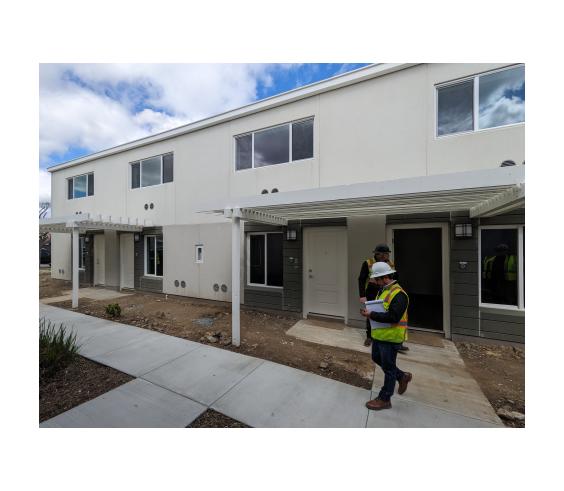
The project is complete. The project team concluded deployment of two prefabricated exterior retrofit panel prototypes with Dryvit-Tremco at the Corona Del Rey Apartments demonstration in Southern, CA (City of Corona). Construction is complete as of March (2024), and M&V activities are complete as well.
Overall, pilot learnings demonstrated that panelized retrofit solutions could support energy retrofits at scale in aging multifamily units across California, but in only limited applications. The project team determined that while panelized retrofit wall systems can provide energy, acoustic, and indoor environmental quality benefits, factors such as cost and other data demonstrated that the majority of California’s building stock, including multifamily housing, may not need aggressive envelope interventions — that is, conventional, market-ready envelope upgrades using commercially available technologies are sufficient for decarbonization.
This project suggests that much of California’s building stock will not require substantial envelope upgrades in standard package deployment. Instead, conventional “market-ready” envelope upgrades using commercially available equipment/materials, such as storm windows, additional insulation (wall and/or attic), and air sealing are sufficient for standard package deployment. However, additional research is needed to determine the viability of panelized envelope solutions in cold climate zones, as a larger percentage of retrofit-eligible buildings will require more aggressive envelope interventions.
The Issue
Envelope improvements are rarely part of any renovation projects due to cost barriers caused by longer construction time. A Net Zero Energy model developed in the Netherlands has developed unitized, prefabricated exterior facade panels that can be installed on an existing building in less than a week. A unitized panel includes windows, doors, and exterior cladding such that once they are attached to the existing building, and there is no other envelope work required. There is currently a lack of prefabrication unitized panels in the U.S. Most of the available products are geared toward new construction and are usually not designed for low-rise California building typology.
Project Innovation
To address this critical gap in the US retrofit market, the project team will test/deploy at least two variations of prefabricated envelope panel prototypes, which will be optimized for the most common multifamily building typology in California: a low-rise, wood-frame building. These panel types and their associated benefits will at a minimum include:
● High insulation and airtightness values
● Fireproof material
● Seismically robust construction
● Low embodied-carbon material
● Lightweight material
● Thin material
The project team will demonstrate each technology on one building each (a total of at least two multifamily buildings) in a larger multifamily complex. The project team will also leverage current research being performed under another EPIC agreement, EPC 17-040, that will create a matrix of all currently identified retrofit wall system technologies to determine whether an additional high potential retrofit wall system could be demonstrated.
Project Goals
Project Benefits
This project designs and develops exterior envelope panels to allow the existing building to remain largely intact while retrofit work is mainly performed outside, which makes the process less disruptive to the building's tenants. Prefabricated exterior retrofit panels can improve quality assurance, reduce renovation time and costs, and significantly reduce thermal loads thereby reducing HVAC energy use and allowing for full electrification of buildings without adding utility bill costs. By increasing the rate of low-load, all-electric retrofits as a turnkey technology, these facade panels can enable California more easily to transition its building stock to carbon-neutral.

Affordability
The project could significantly reduce utility bills for millions of low income families in California. The project will result in the ratepayer benefits of greater electricity reliability, lower costs, and increased safety. The prefabricated panel will reduce thermal loads of the building, thus reducing heating and cooling costs.

Environmental Sustainability
California has 2 million units for low income multifamily buildings. If all units receive prefab façade panel retrofits, it could result in significant GHG reduction due to reductions in energy use for heating and cooling homes.
Affordability
The project will result in the ratepayer benefits of greater electricity reliability, lower costs, and increased safety. The prefabricated panel will reduce thermal loads of the building, thus reducing heating and cooling costs.
Key Project Members

Auri Bukauskas
Nick Jiles
Maura Mooney
Subrecipients

Association for Energy Affordability
Redwood Energy, LLC
David Baker Architects
Signetron, Inc.
RDH Building Science Inc.
National Community Renaissance
Match Partners
Association for Energy Affordability
Rocky Mountain Institute
Signetron, Inc.
RDH Building Science Inc.