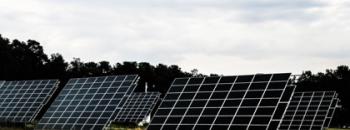
Smart, Hybrid, Grid-Connected Exterior Lighting Systems.
The project develops and demonstrates technology focused on hybrid power (solar and grid-tied) exterior Light Emitting Diode (LED) area light system using a unique wrap-around solar panel with embedded sensors, controls and monitoring in the

Electric Power Research Institute, Inc.
Recipient
Palo Alto, CA
Recipient Location
13th
Senate District
23rd
Assembly District
$407,586
Amount Spent
Active
Project Status
Project Update
The project has completed development, testing, manufacturing, and conducted field installations at five sites out of six for the new street pole lighting application as a complete retrofit solution using existing infrastructure. All installations are in low income or disadvantaged communities to provide maximum project benefits. The project is awaiting one remaining site installation at Seacliff Highlands, Aptos.
Data from the five (5) installed sites demonstrate that the hybrid fixtures can significantly reduce and in some cases eliminate the need for AC grid power to meet lighting requirements on most days. While performance varies by season and location, EPRI data shows that in high sun conditions (e.g., minimal shading) or regions with frequent sunshine, some installations have operated for entire weeks without drawing grid power. In applications/locations with regular overcast or cloudy conditions, several hybrid poles have routinely operated with little to no AC power for entire weeks. Even in installations with heavy shading, persistent cloud cover, or during months of limited sunlight, the hybrid systems have consistently achieved grid power reductions exceeding 50% most weeks. Apart from energy reduction, preliminary results from surveys of space occupants and residents have reported positive responses and appreciation of the retrofit lighting that provides improved overall illuminance compared to the HID systems which they have replaced.
The Issue
A significant amount of California’s street and area lights use alternating current (AC), are tied to the electric grid and are operated in an ON / OFF function using photocells and do not offer fixture level dimming, circuit level control, occupancy sensing, energy monitoring, or remote fixture monitoring /control. Because of this, the exterior lights operate at full illuminance for more hours than needed and often at night when solar energy is not available. Since there is little renewable energy available at night, finding solutions to reduce nighttime load is important to minimize greenhouse gas emissions from electricity generated from fossil fuels.
Project Innovation
This project develops a novel innovative lighting product that has the potential to operate in a way that would be beneficial to the electric grid. This includes having the ability to dim, to remotely control, schedule or monitor fixtures and to operate in a way to maximize use of renewable energy. This project developed a product that includes flexible solar panels with battery storage, innovative flexible solar panels that wrap around the light pole and integrated lithium-ion batteries, and fixture level storage helps to ensure that illuminance can be provided regardless of the state of the grid. Use the electric grid to provide backup power, local dimming control, motion sensing, as well as individual and grouped luminaire scheduling, along with the ability to respond to demand response (DR) signals. Ability to report and collect data on energy consumption and operations (e.g., schedule), and high-quality light, properly aimed at and shielded to reduce glare.
Project Goals
To demonstrate a reliable, hybrid solar LED luminaire that optimizes charging based on grid conditions
To demonstrate new multi-feature lighting product & measure illuminance & energy consumption during on & off-peak periods.
Project Benefits
The incorporation of a flexible solar panel with an integrated battery storage could collect and store solar energy for use at night, which may reduce electricity bills while reducing night-time lighting load on the grid. Motion sensors and wireless controls are intended to be integrated into the LED luminaire that may provide further reduction in the energy used, prolonging the battery charge level.

Safety
Safety
A hybrid exterior luminaire powered by both the utility grid and the integrated batteries will provide added safety, reliability and security during fires or emergency shut off events such as PG&E's PSPS program. Powering the fixture using integrated Photovoltaics and batteries will significantly reduce grid energy consumption and reduce energy cost by more than 80 percent.

Affordability
Affordability
This technology benefits residents and small business owners by reducing operating costs while having effective lighting. The motion controls aim to ramp up the lights to full brightness when motion is detected, thus reducing energy use.

Environmental Sustainability
Environmental Sustainability
The project can help reduce the amount of non-renewable electric grid power required at night. The technology deployment for all outdoor lighting in CA, estimates 4,000 GWh of electricity could be offset per year which equates to 132,000 tons of carbon dioxide emissions reduction.

Reliability
Reliability
The project provides for greater reliability in exterior street lighting and offers a solution to operate off-the-grid, so a power outage won't leave residents in the dark.