Real World Electrification Options of Energy Services and Environmental Justice (EJ) Considerations
Evaluating opportunities for electrification in California
Electric Power Research Institute, Inc.
Recipient
Palo Alto, CA
Recipient Location
13th
Senate District
23rd
Assembly District
$799,098
Amount Spent
Completed
Project Status
Project Result
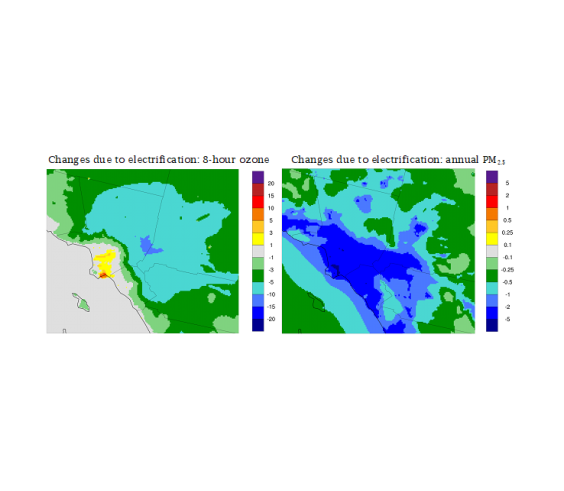
The research team delineated long-term electrification scenarios for the residential, commercial, and transportation sectors. For each scenario, researchers estimated emissions of criteria air pollutants at relatively fine geographical resolution and with the necessary temporal resolution for sophisticated photochemical modeling. Results suggest that electrification would result in substantial improvements in air quality and public health based on estimated reductions in maximum summertime 8-hour average ozone concentrations and wintertime PM2.5 concentrations. This analysis of health and air quality benefits alongside costs of electrification offers a basis for new cost-benefit metrics that can be used to assess the economic viability of breakthrough technologies
The Issue
Electrification of energy services that depend on fossil fuel combustion can create substantial benefits for California ratepayers and residents, including improved air quality, reduced greenhouse gas emissions, and significant cost savings. However, the cost-to-benefit ratio as well as distribution of benefits vary widely based on technology as well as the specifics of its application (e.g., location, use pattern). Understanding the magnitude and distribution of health benefits associated with electrification scenarios is critical to design and implementation of programs designed to achieve electrification objectives and address environmental justice issues.
Project Innovation
The research team conducted a detailed study about the air quality implications of electrifying energy services such as transportation and space heating. The research team used, as a starting point, E3's prior EPIC study on [i]Deep Decarbonization in a High Renewables Future [/i](EPC-14-069). Estimates of how emissions of criteria air pollutants such as oxides of nitrogen and particulate matter would change with electrification were used as input to a sophisticated air quality model to estimate air quality impacts. The research team evaluated the implications of these air quality improvements on public health.
Project Goals
Project Benefits
The analysis of health and air quality benefits alongside costs of electrification under this agreement is forming the basis for new cost-benefit metrics that can be used to assess the economic viability of breakthrough technologies. Cost-benefit analyses of this sort can be used to make evidence-based decisions regarding technology financing and deployment.

Affordability
Electrification of customer energy technologies and services can create a number of benefits for California ratepayers and residents, including improved air quality, reduced greenhouse gas emissions, and significant cost savings. The project showed cost and benefits to utility customers of specific electrification technologies.

Environmental Sustainability
This research provided information on the benefits of electrification for public health and the environment. Electrification of customer energy technologies, including homes, businesses, industry, and mobile sources can reduce greenhouse gas emissions. The final research results suggest that ozone and particulate matter concentrations would go down substantially in an electrification scenario, resulting in significant public health benefits.
Key Project Members

Marcus Alexander

Eladio Knipping
Subrecipients

Ramboll Environ US Corporation
Match Partners
Electric Power Research Institute, Inc.
South Coast Air Quality Management District