Modeling the Impact of Wildfires on California's Transmission and Distribution Grid
Identifying regions of the electricity grid most vulnerable to future wildfires and evaluating adaptation strategies.
Lawrence Berkeley National Laboratory
Recipient
Berkeley, CA
Recipient Location
9th
Senate District
14th
Assembly District
$500,000
Amount Spent
Completed
Project Status
Project Result
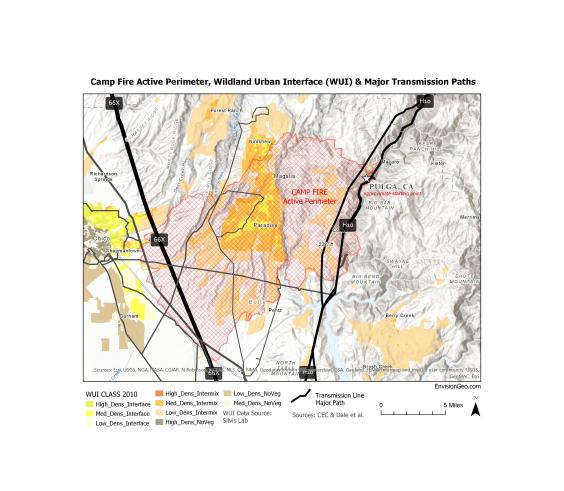
This project was completed in 2018. The final report, included in California's Fourth Climate Change Assessment, is available online at http://www.climateassessment.ca.gov/techreports/docs/20180827-Energy_CC…. The researchers obtained the maps of future burned area being used for California's Fourth Climate Change Assessment as the basis for their study of future risk to the transmission and distribution system. They mapped current and future exposure of operationally significant segments of transmission paths to wildfire. They used land use projections of urban expansion as a proxy for the extension of the distribution grid. Then they used the PLEXOS model to estimate the cost of fire-caused outages with and without wildfire forecasts, such as the change in generation costs as other power plants are dispatched to replace the stranded generators during the outage.
View Final ReportThe Issue
Climate projections indicate longer, warmer dry seasons in California, thus increasing the risk of large wildfires. Previous research funded by the Energy Commission established that some climate change scenarios could cause a substantial increase in exposure of major existing transmission lines to wildfire, but the vulnerability of distribution circuits has yet to be investigated. Research is needed to extend this previous assessment of vulnerability of the transmission system in California to include the distribution system.
Project Innovation
This study advanced scientific knowledge by combining and enhancing several state-of-the-art models to produce the most detailed analysis to-date of California's current and future electric transmission and distribution grid and fire risk under alternative conditions of climate change and grid evolution.
Project Goals
Project Benefits
The project identified segments of the electric grid that are now or will become most vulnerable to increasing wildfire risk. This knowledge allows operators to improve maintenance of grid reliability and safety while adapting to the challenge of changing climate. Researchers applied a unique methodology to measure wildfire risk, allowing them to relate an evolving wildfire probability over time with an evolving electricity grid. The methodology analyzed the cost benefits of grid adaptations for minimizing the risk associated with future wildfires.

Affordability
The study modeled the cost benefits of maintaining a reliable electricity supply in the face of increased wildfire risk. Over 2000-2016, wildfire damages to the transmission and distribution system exceeded $700 million.

Reliability
The project explored adaptation strategies for minimizing impacts of wildfire, including avoiding high fire risk areas for new transmission paths and undergrounding selected paths.

Safety
Greater ratepayer safety follows from improved electricity system reliability, because that reduces the potential hazards associated with power outages, such as public health and operations of critical facilities.
Key Project Members

Larry Dale

Max Wei

David Stoms
Subrecipients

Greenware Technologies
Envision Geo LLC
Match Partners
University of Hawaii at Manoa